
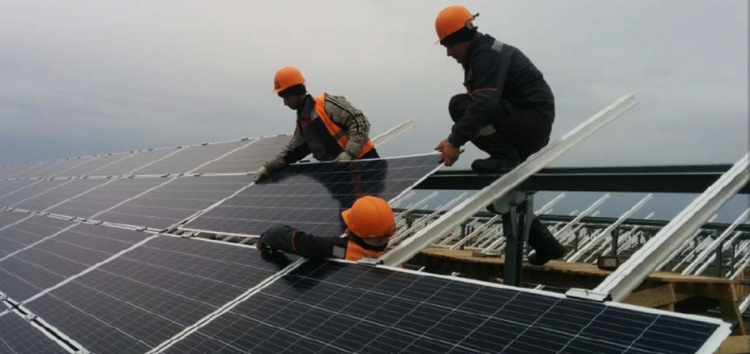
EBRD said that the finance and project support agreements for the new solar plant were signed in Astana, the capital city of Kazakhstan. Of the overall funding, EBRD will provide $51.3m for the project, while GCF will provide a loan of up to $22.2m.
EBRD has partnered with Joachim Goldbeck Holding, a new investor in Kazakh’s renewable energy sector, to build the plant, which is expected to strengthen the renewable energy sector in Kazakhstan.
The solar project will be owned by Joachim Goldbeck Holding and will be delivered by SES Saran, a special-purpose company incorporated in Kazakhstan.
Touted to be largest solar power plant built at one time in Central Asia, the new solar plant is expected to avoid CO2 emissions up to 93,500 tons per annum. It will also help in reducing the Kazakhstan’s national emission targets along with the EBRD’s Green Economy Transition strategy.
Furthermore, the Saran solar plant is expected to reinforce the private sector’s contribution in the power and energy sector which was historically dominated by state entities.
The solar project forms part of the EBRD-GCF Kazakhstan Renewables Framework, which has been designed to boost investments in renewables, offer technical assistance and build institutional capacity for energy integration, renewable energy, carbon market policies and planning.
The project extends the cooperation between EBRD and the Ministry of Energy of the Republic of Kazakhstan to develop renewable energy and Kazakh emissions trading scheme (ETS) in the country. It is line with a memorandum of understanding signed by both parties in 2017.
Since 2006, EBRD has committed €26.7bn through its Green Economy Transition approach with €6.3bn invested in renewable energy, both directly and through credit lines. The bank said that more than 10,000MW of total renewable capacity has been installed.
Until date, EBRD has invested more than €7.5bn in Kazakhstan through 246 projects.


