

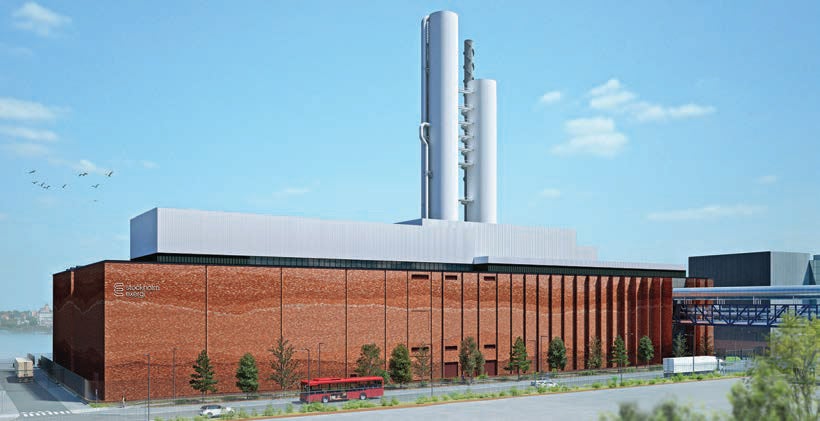
BECCS Stockholm is located in the port area close to the Värtaverket power plant site in Stockholm and will capture CO2 from flue gas produced by Stockholm Exergi’s biomass fuelled KVV8 CHP plant.
KVV8, commissioned in 2016, is the newest CHP plant at the Värtaverket site, with an installed capacity of 135 MWe/330 MWt. It runs on wood chips derived from forestry and sawmill residues, bark, branches and treetops, and employs a circulating fluidised bed boiler plus automation supplied by Austria based Andritz.
The SEK 13 billion BECCS Stockholm investment decision “marks a major milestone” in enabling permanent CO2 removals and “will help Sweden and the European Union reach their long-term climate goals,” says Stockholm Exergi.
“We have worked purposefully for many years to make BECCS a reality and…we are moving from plans to action. With this, we assume global leadership in the industry for permanent removals,” says Anders Egelrud, Stockholm Exergi CEO.
The positive investment decision has been made possible through a combination of public support and private purchases of negative emission certificates by companies with ambitious climate targets. The project has received funding from the Swedish government and EUR 180 million from the EU Innovation Fund. It also has long-term offtake commitments from Microsoft (3.33 million tonnes) and Frontier (USD ~50 million) an ‘advance CO2 market commitment’ group that includes Meta, Stripe, Alphabet, Shopify and McKinsey.
Once completed, the BECCS facility will capture and permanently store 800 000 tonnes of CO2 annually — more than the emissions from Stockholm’s road traffic over the same period, Stockholm Exergi notes.
The technology selected for capturing CO2 has been in use for many decades observes Stockholm Exergi, which has operated a test facility since 2019. The storage method is also well-proven and closely monitored to ensure the CO2 is permanently stored in bedrock beneath the seabed where it mineralises over time, the company points out.
Stockholm Exergi will work with Northern Lights as its partner for CO2 transport and storage. The Värtaverket BECCS investment decision now enables Northern Lights to expand its capacity — an “important step for future negative emissions projects and the foundation for what could become a new industry, positioning the Nordics and Europe as global leaders in this field.”
Saipem of Italy will carry out the detailed EPC and commissioning of the carbon capture, CO2 storage, and ship loading systems for BECCS Stockholm under a 600 million euro contract with Stockholm Exergi.
Stockholm Exergi, which has a 3000 km district heating network, provides heating, electricity, cooling, and waste services to 800 000 residents of Stockholm. It is owned by the City of Stockholm and Ankhiale, a consortium of leading European pension funds (APG, PGGM, Alecta, Keva and AXA IM Alts).
Capture technology
Interestingly, instead of amines, BECCS Stockholm will employ Catacarb Enhanced Hot Potassium Carbonate (HPC) technology for its core capture system, in conjunction with Capsol’s integrated heat recovery “end-of-pipe solution”, CapsolEoP, which aims to maximise heat re-use and reduce costs.
While capturing carbon dioxide from flue gas is a relatively new application for Catacarb, the technology is said by its owners to be already proven with over 200 licensed applications in 34 countries.
The Catacarb process, available under licence from USA based Eickmeyer & Associates, was first implemented in 1961, and is “enabling a variety of industries to selectively remove CO2 from mixed-composition gas streams”, with Catacarb units capturing over 50 000 tons of CO2 daily, the company says.
“Unlike some competing technologies, there are no carcinogens formed in the process,” says Gary Buckholz, CEO of Catacarb, which is owned and operated by Eickmeyer & Associates.
The Catacarb process was invented and developed by A.G. Eickmeyer. As an employee of Stanolind Oil & Gas Co and J.F. Pritchard & Co in the 1940s and 50s, he became familiar with the Hot Potassium Carbonate (HPC) process being developed by the US Bureau of Mines.
Eickmeyer believed the HPC process had many advantages, but through his trouble-shooting work on most of the early HPC installations, he also became aware of some drawbacks, which he addressed. The process required substantially less heat than the amine processes, but absorption/desorption rates were low. In addition, the equipment was too large, and the solution was sometimes corrosive.
Through the development of various catalysts and corrosion inhibitors, Eickmeyer & Associates has steadily improved on the original HPC process, culminating in today’s Catacarb process. In May 2024, Andritz reported that it had expanded its carbon capture technology portfolio via a licensing agreement with US Eickmeyer & Associates Inc, giving the Graz based company access to Catacarb and widening the range of industries to which it can provide capture systems (although Andritz has not been named as a supplier to the BECCS Stockholm project).
In July 2022, Stockholm Exergi signed a patent licence agreement for the use of Capsol’s technology at KVV8.
Norway based Capsol Technologies believes its role in the BECCS Stockholm project positions it as “a front runner in the emerging market for negative emissions and highlights the increasing maturity of carbon removal markets.”
According to Wendy Lam, CEO of Capsol Technologies, the Stockholm project creates “a global precedent for BECCS deployment and further strengthens confidence in Capsol’s technology.”
Capsol says its CapsolEoP technology is “particularly attractive for energy-from-waste and biomass plants with limited excess heat.” “With the first FID for a large-scale project using our technology now in place [BECCS Stockholm], we expect this to accelerate commercial traction and de-risk adoption across industries,” said Lam, with the Stockholm Exergi project highlighting the scalability of BECCS and Capsol’s growing role in enabling carbon-negative projects globally.
Capsol says its technology is based on 15+ years of R&D and “can run fully electric, requires no external steam, and has little to no water need.” The first successful test of the technology was performed in 2008 at Värtaverket.
The company says it currently operates three carbon capture (CapsolGo) and two liquefaction demo units on several flue gas streams in Europe.
The technology platform with its “inherent heat recuperation and generation” is said to be applicable to all hard-to-abate industries, with flue gas CO2 concentrations in the range 3-30%.
The CO2 purity of the dried gas exceeds 99%, meeting “storage and utilisation requirements.” Capsol also says its pressurised absorber design uses less plot space than competing technologies.
The use of HPC for post-combustion (from flue gases) carbon capture was, until recently, discarded as a viable option, says Capsol, due to the high energy demand (and cost) required to pressurise the flue gas before it enters the absorber. CapsolEoP was developed to address this. The capture unit can run on electricity only and there is no need to build an additional boiler for steam production. The electrical energy consumption is between 0.5 and 1.5 GJ/tons of CO2 captured, depending on the composition and temperature of the flue gas.
This article first appeared in Modern Power Systems magazine.


