
The organic Rankine cycle (ORC) is a closed thermodynamic cycle that operates with an organic working fluid, usually refrigerants or hydrocarbons characterised by low evaporation point, able to recover heat from industrial processes (eg, cement, glass, steel production) and transform it into electricity via a turboexpander.
These power generation plants, usually referred to as waste heat recovery (WHR) ORC, are characterised by a limited working fluid temperature at the expander inlet (up to 250°C) and a limited volumetric flow at the expander outlet (10-20 m3/s).
For these operating conditions, Exergy has developed, thanks to a Ricerca e Innova grant under the Lombardy Regional Program, FESR 2021-2027, a new series of high-speed axial turbines (HSAT) optimised in terms of design and performance for modular WHR ORC plants, ranging from 0.7 MWe up to 2 MWe of electric power. The new turbine technology enables ORC systems of this size and operating in this temperature range to achieve more efficient electricity generation and thus be more economically viable.
The high-speed axial turbine
The trend in the WHR ORC sector towards smaller plants with reduced flow rates strongly demanded the development of a new compact axial turbine, operating at a higher speed (12000 rpm). Compactness was a key aspect to maintain acceptable blade heights at the first stage as well as to limit the radial displacements of the rotor stages due to thermal expansion and centrifugal force. Limiting radial displacements during operation also allows the adoption of narrow labyrinth seal clearances, with a beneficial effect on leakage losses.
A compact design was also required to reduce the turboexpander package manufacturing costs, compensating for the introduction of a reduction gearbox (4:1) to accommodate the high rotational speed. With the HSAT, a cost reduction of 20% has been achieved compared to Exergy’s standard expanders (eg, employing radial outflow, see text box at the end of this article).
Multiple integrally bladed rotors
To make the axial turbine suitable for modular WHR ORC plants with a range of electrical power outputs (0.7MWe and upwards), a multiple integrally bladed rotor (MIBR) configuration has been engineered, see Figure 1.
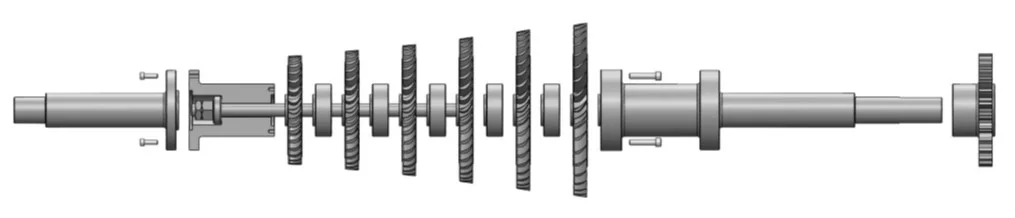
It consists of multiple stages and spacers held together by a single central tie rod, with torque between each stage transferred by means of interstage friction disks. This rotor section configuration can easily accommodate additional stages for ORC plants where higher expander enthalpy drops are required by the cycle. The rotor blades are integrally machined on the rotor disks, reducing the number of components and manufacturing times significantly.
Sliding mechanical group bushing
The expander rotor is contained in a three casing layout , two radially split at the inlet and outlet sections, and one axially split in the central section, see Figure 2. This configuration, not very common for axial expanders, was selected to reduce maintenance times and costs.
Exergy’s patented sliding mechanical bushing (shown in detail in Figure 2), thanks to a combination of spacers, o-ring seals, and centring notches, allows fast replacement of the main expander consumables. With this innovative solution, bearings and mechanical seals can be easily replaced, in half a day, without draining the working fluid, which stays safely confined to the central section of the casing.
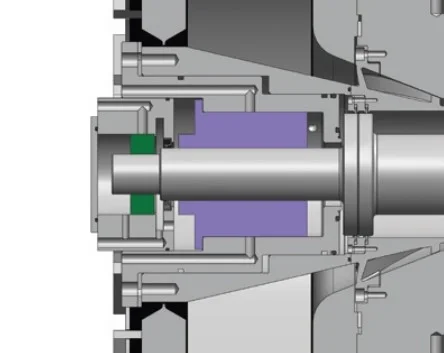
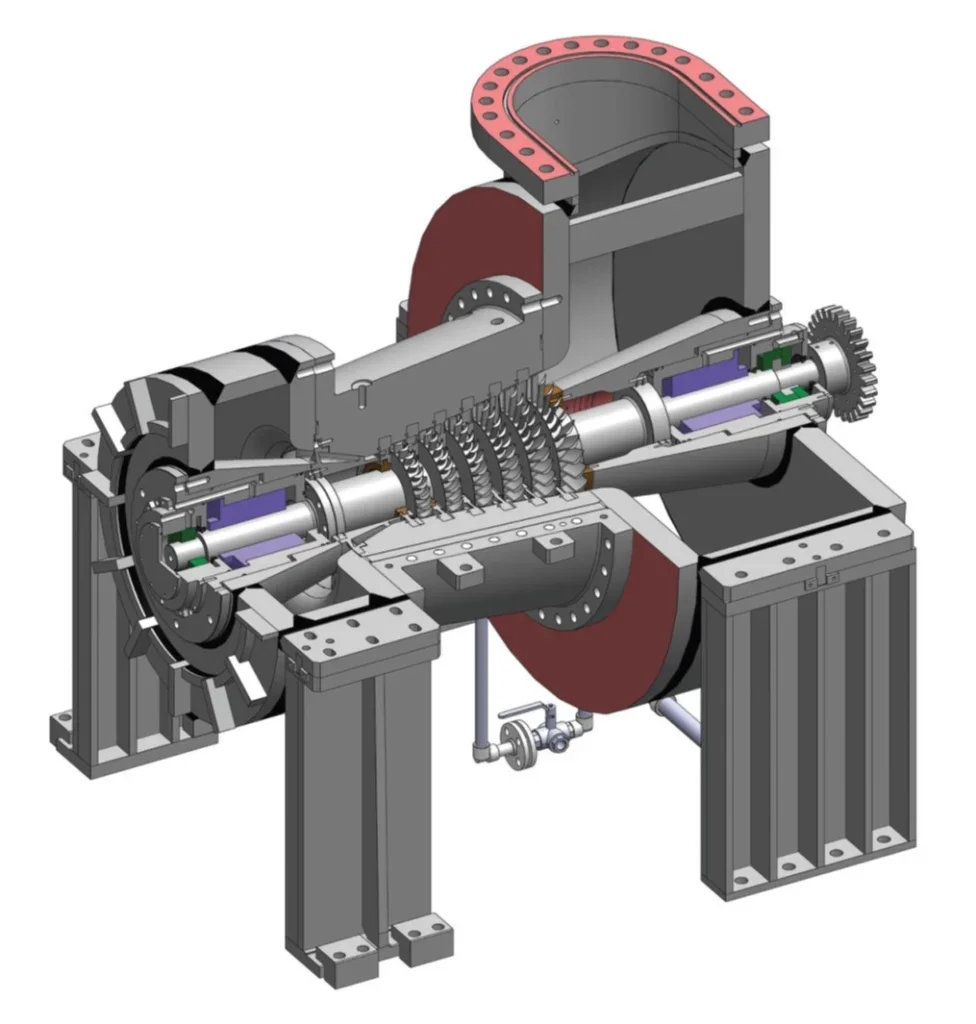
The bushing system used in combination with calibrated thickness spacers and angled labyrinth seals enables on-site clearance control, directly affecting turbine performance by controlling leakage losses.
Rotordynamics
Operating at a rotational speed of 12000 rpm requires accurate rotordynamic analyses to exclude any vibration related issue during operation given the supercritical rotor design. State-of-the-art EDM machined journal bearings that act like tilting pads have been adopted to guarantee enough damping and a safe crossing of the rotor’s natural frequencies during startups and showdowns.
Applications – waste heat recovery unlocked
The high-speed axial turbine has been specifically designed for ORC power plants in industrial waste heat recovery applications. Potential implementations include cement factories, glass production, steel production, as well as high-temperature heat recovery from engines, gas turbines and waste-to-energy plants. In these sectors, available waste heat is typically in the range of 4 to 30 MWt and is generally recovered via flue-gas-heated boilers, with heat transferred to users via thermal oil loops. Operating temperatures are consistently around 300°C at the boiler outlet and 150°C at the return. ORC technology represents the ideal solution for power generation in this context, efficiently converting thermal energy into electricity without any consumption of water, an increasingly scarce and valuable resource.
The integration of HSAT with high-effectiveness once-through evaporators developed under the Ricerca e Innova initiative, has increased conversion efficiency by 2 to 3 percentage points compared to conventional systems. This enhancement unlocks greater electricity generation per unit of recovered heat. According to KCORC (Knowledge Center on Organic Rankine Cycle) estimates, industrial waste heat recovery across Europe could generate up to 150 TWh of electricity annually, avoiding approximately 123 million tons of CO2 emissions per year.
Small size, high efficiency
In summary, Exergy’s high-speed axial turbine is designed to be a good fit with trends in the WHR ORC technology space, increasing feasibility in small size applications thanks to increased efficiency and competitiveness. Its multiple integrally bladed rotor design guarantees the applicability of the same turbine layout over a range of different plant sizes, from 0.7 MWe up to 2 MWe. The patented sliding mechanical group bushing reduces maintenance times and costs significantly, with the possibility of altering expander performance on-site thanks to the labyrinth seals’ clearance adjustment control. The use of advanced bearings and mechanical seals ensures smooth operation at high rotational speed, ensuring high reliability.
New Azores geothermal project will employ Exergy’s radial outflow turbine technology
Exergy has been awarded a €24.5 million contract by EDA Renováveis (EDAR) for the design, manufacturing, construction and commissioning of a 5 MWe geothermal binary plant in Ribeira Grande, on the island of São Miguel, Azores. This will employ the company’s well established radial outflow turbine technology (pictured below).
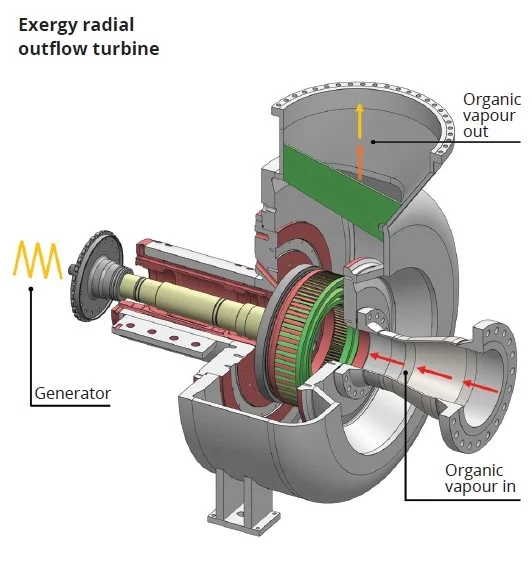
The project entails the revamping of the Ribeira Grande geothermal plant, which has been in operation since 1994. Two of the four existing ORC units, each rated at 2.5 MWe, will be replaced with a new 5 MWe unit. Exergy’s ORC system, based on a single-pressure-level cycle, will harness a geothermal resource at approximately 150°C in both brine and steam phases to produce clean electricity.
The cycle is designed to utilise all available heat content of the steam, minimising geothermal fluid loss. Additionally, the high isentropic efficiency of the Exergy radial outflow turbine will enable the generation of approximately 5.3 MWe of net power, exceeding the 5 MWe requested by the plant owner/ operator, thus enhancing the overall competitiveness of the systems. An air-cooled condensing system will be used to avoid water consumption, and the geothermal steam and brine will be reinjected into the well at the ORC outlet.
Exergy’s scope of work includes the full EPC (engineering, procurement and construction) of the ORC plant and associated gathering systems. The plant is planned to be fully operational before the end of 2026 with the first provisional take-over (partial) scheduled for the end of June 2026.
This is the second contract awarded to Exergy by EDA Renováveis, the renewable energy division of Azorean utility company EDA, following the successful supply of the 4 MWe Pico Alto plant on Terceira Island, which has been in operation since 2017.
Geothermal is the most important renewable resource in the Azores, accounting for around 21% of the total electricity demand in the region in 2024, despite current exploration being limited to the islands of São Miguel and Terceira. The Azores hosts three geothermal plants: two in São Miguel (10 and 12 MWe), and one 4 MWe (Exergy) plant in Terceira.
This article first appeared in Modern Power Systems magazine.


